 By Audrey Hayes
Updated November 2026
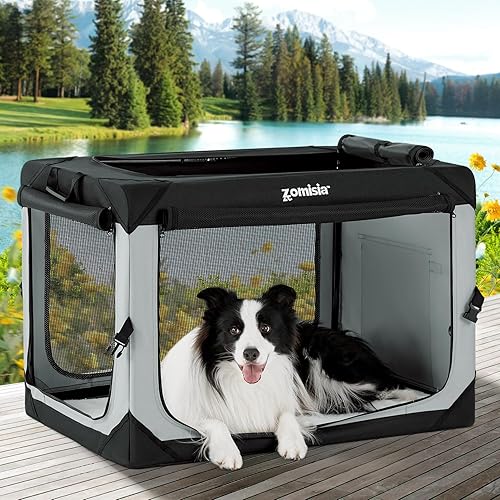
XL dog crate measurements are based on your dog’s length, height and weight, but the exact numbers vary by brand. To size one correctly, measure your dog from nose to base of tail and from the floor to the top of the head while standing, then add room for comfort. A crate should let your dog stand, turn around and lie down stretched out, without much extra space.
Why Crate Size Matters
A crate that is too small makes a dog feel cramped, and many dogs will not rest well in one. A crate that is too large can work against training. Dogs often use one end as a bathroom and the other as a bed, which defeats the purpose of a den-like space. The goal is a crate that fits your dog now and, for puppies, one that can be adjusted as they grow.
Shopping for one? See our guide: 5 Best Crates for XL Dog Picks Compared for Large Breeds (2026).
Key Measurements to Take
Use a soft tape measure and take these three numbers with your dog standing naturally:
- Length: from the tip of the nose to the base of the tail, then add 4 to 6 inches.
- Height: from the floor to the top of the head or ears, then add 2 to 4 inches. Dogs with tall ears may need more.
- Width: measure across the widest part of the shoulders or hips, then add 2 to 4 inches.
Compare your totals with the interior dimensions listed by the manufacturer, not the exterior. Many crates lose several inches to wire walls, trays and door frames.
Common Sizing Mistakes and How to Avoid Them
The most common error is buying by weight alone. Two dogs of the same weight can have very different body shapes, so a long, low dog may need a longer crate than a compact dog of the same weight. Another mistake is buying a crate large enough for a full-grown dog when you have a young puppy. A bigger crate can be made smaller with a divider panel, which many XL models include. Check the crate’s manual for how divider panels are installed.
Practical Steps for Choosing the Right Size
- Measure your dog’s length, height and width as described above.
- Add the recommended extra space to each number.
- Compare the totals with the interior dimensions of each crate you are considering.
- If your dog is still growing, choose a crate with a divider or plan to upgrade.
- Place the crate where you plan to use it and confirm it fits the space with room to open the door.
- Watch your dog’s first few days in the crate. If they cannot lie down or stand comfortably, reconsider the size.
What We’d Use
For a dog that needs a large, sturdy enclosure, a heavy-duty wire crate with a divider is a practical choice.
View on Amazon
For a dog that needs a quieter, more furniture-like option, look for an XL crate with a solid top and tray.
View on Amazon
For more guidance, see XL Dog Crate Dimensions: How to Measure and Choose the Right Size (2026) and Large Dog Crate Measurements: How to Get the Right Size (Step-by-Step). If you are still unsure, talk with your veterinarian or a certified dog trainer about your dog’s build and needs.
FAQ
How much bigger than my dog should an XL crate be?
Aim for about 4 to 6 inches of extra length and 2 to 4 inches of extra height and width. Your dog should be able to stand, turn and lie down stretched out.
Can I use one crate size for a growing puppy?
Many owners use a crate with a divider panel so the space can be reduced while the puppy is small. Adjust the space as your puppy grows, and avoid giving more room than needed for housetraining.
Do I need to measure my dog if I know their breed?
Breed averages are a rough guide only. Individual dogs vary a lot, so measuring your dog directly gives you more accurate numbers.
Related reading
- XL Dog Training Crate: How to Choose and Set Up the Right One
- Kong XL Dog Crate: Sizing, Setup and Picks for Large Dogs (2026)
- Furniture Dog Crate XL: 6 Best Picks for Large Dogs (2026)
- Wood Dog Crate Furniture: 6 Best Picks for Indoor Use (2026)
Ready to choose one?
About Audrey Hayes
Audrey Hayes is part of our editorial team and reviews and edits our dogs & puppies guides, checking product details against manufacturer specifications and owner feedback.