 By Audrey Hayes
Updated November 2026
Choosing the right great dane dog crate size comes down to measuring your dog and adding a few inches of room, so your Dane can stand, turn around and lie down stretched out without wasting space. This guide walks you through the measurements that matter, how to account for a growing puppy, and the mistakes that send many owners back to the store.
Step 1: Measure Your Great Dane Correctly
Take three measurements while your dog is standing naturally, not hunched or stretched. Use a soft tape measure and have someone hold your dog still if needed.
Shopping for one? See our guide: Size of Large Dog Crate: 5 Best Picks Compared for Big Dogs (2026).
- Length: Measure from the tip of the nose to the base of the tail, then add 4 to 6 inches.
- Height: Measure from the floor to the top of the shoulder (withers), then add 2 to 4 inches for head clearance.
- Width: Measure at the widest point of the body, usually the shoulders or ribcage, then add 3 to 4 inches.
Adult Great Danes commonly need a crate with interior length somewhere in the 48 to 54 inch range and a height that clears their head when they stand. Always compare your own numbers against the manufacturer’s interior dimensions rather than the outside measurements listed on the box, since panel thickness and frame bars reduce usable space.
Step 2: Plan for Growth If You Have a Puppy
Great Danes grow fast, so buying for the adult size is usually the better plan, but a crate that is far too large can let a young dog use one corner as a bathroom. A common approach is to use a divider panel, which most large wire crates include, to shrink the usable floor space while your puppy is small. Remove panels gradually as your dog gains size, and check the fit every few weeks.
Puppies that are still growing will often need a new crate or extra panels within the first year, so measure again at each stage rather than relying on your first set of numbers. For breed-specific growth timelines, a veterinarian or breeder can give you more accurate guidance.
Step 3: Check the Crate Fit by Watching Your Dog
Measurements give you a starting point, but observing your dog gives you the final answer. In a properly sized crate, your Dane should be able to:
- Stand up and turn around fully without touching the top or sides.
- Lie down with legs extended if needed, without pressing against the walls.
- Rest comfortably at one end while keeping the other end clearly separate as a potty area for puppies.
If your dog cannot turn around, the crate is too small. If your dog uses one end as a bathroom or seems to roam, it may be too big.
Step 4: Choose the Right Crate Type for a Large Breed
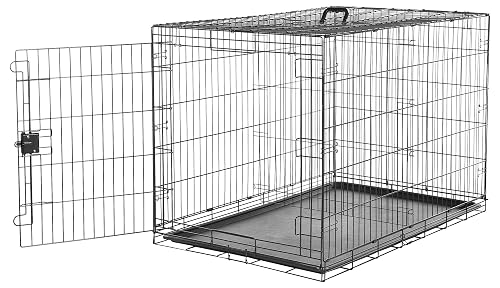
Wire crates are the most common choice for Great Danes because they offer strong ventilation and a clear view of the room, and many owners find them easy to size with divider panels. Heavy-duty plastic and furniture-style crates are also used, though they need to be checked for weight rating and interior dimensions. Strong-willed or heavy-chewing dogs may need reinforced latches and sturdy construction. Check the official manufacturer specifications for load limits before you buy.
Common Mistakes to Avoid
- Measuring the outside of the crate instead of the interior.
- Buying a crate that only fits the dog’s length but not the height needed to stand comfortably.
- Skipping divider panels for a puppy and letting it get too much space.
- Forgetting to recheck the fit as your dog matures.
- Assuming a crate sized for a medium breed will work for a Great Dane.
Recommended Gear
- Wire crate with divider panel: A divider lets you adjust usable floor space as your puppy grows. View on Amazon
- Orthopedic crate mat: A thick, supportive mat helps a large dog rest comfortably on a hard floor. View on Amazon
- Soft measuring tape: A flexible tape makes it easy to measure length, height and width accurately. View on Amazon
For more options, see 6 Best Dog Crates for a Great Dane: Heavy-Duty Picks (2026) and XL Dog Crate Dimensions: How to Measure and Choose the Right Size (2026). If you are also planning a bed for after crate training, Dog Bed Great Dane: How to Choose the Right Size and Support (2026) covers sizing for large dogs.
FAQ
What size crate does a full-grown Great Dane need?
Most adult Great Danes need an interior length around 48 to 54 inches and enough height to stand with head clearance. Always confirm against your dog’s measurements and the manufacturer’s interior specs.
Should I buy a bigger crate for my Great Dane puppy?
You can buy the adult size and use a divider panel to limit space while your puppy is small. This keeps the crate useful as your dog grows without giving a young puppy room to soil one end.
How do I know if my Great Dane’s crate is too small?
If your dog cannot stand, turn around or lie down with legs extended without touching the walls, the crate is too small. Discomfort during crate time can also signal a fit problem, so check with your veterinarian if you notice stress or injury.
Conclusion
Measure your Great Dane’s length, height and width, add clearance, and compare those numbers to the crate’s interior dimensions. Recheck the fit as your dog grows, and use divider panels when you need to adjust space. A well-sized crate keeps your dog comfortable and makes crate training far easier.
Ready to choose one?
About Audrey Hayes
Audrey Hayes is part of our editorial team and reviews and edits our dogs & puppies guides, checking product details against manufacturer specifications and owner feedback.